
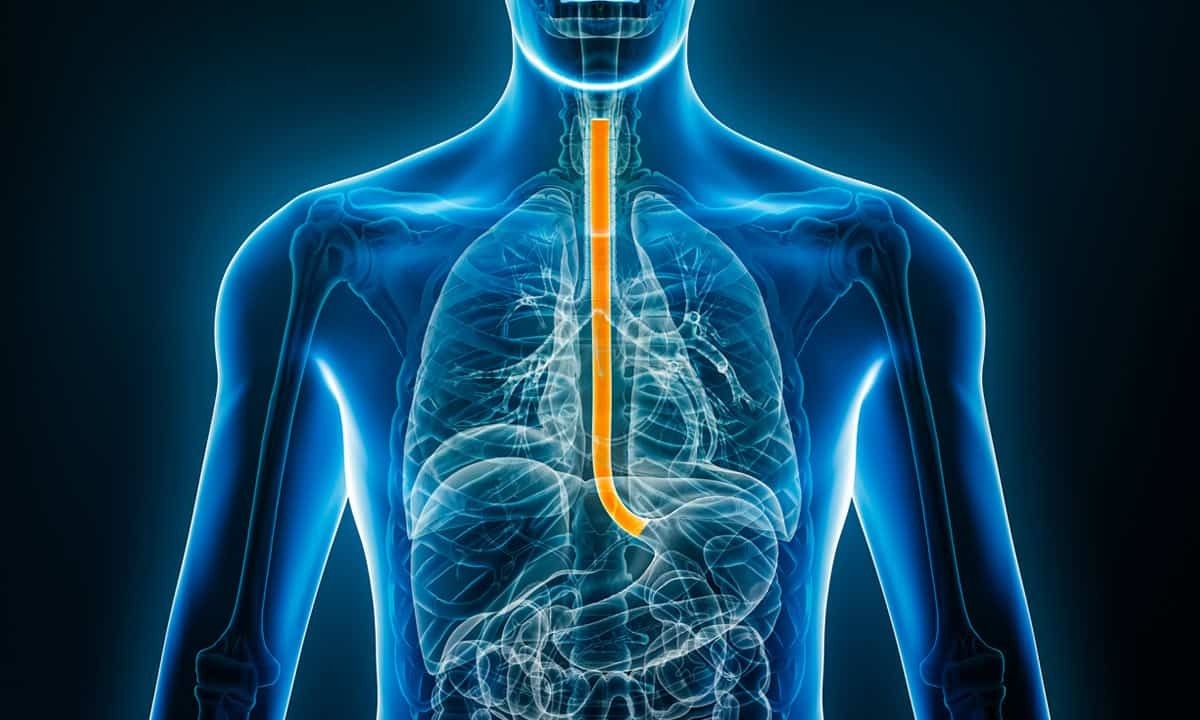
Esophageal Cancer Screening: Who Needs It and Why
Like other forms of cancer, esophageal cancer can develop quietly over many years before causing any noticeable problems. The disease tends to progress without early warning signs, which means patients often don’t seek care until symptoms become impossible to ignore. By that point, the cancer is typically well-established and harder to treat. But esophageal cancer also progresses through a series of identifiable tissue changes that unfold slowly enough to create a window for detection. Screening is designed to catch those changes before they advance to invasive cancer.
Esophageal Cancer: Two Diseases With Different Drivers
Esophageal cancer has two distinct forms that develop in part based on the type of cell involved. Esophageal adenocarcinoma (EAC) arises from the glandular cells that line the lower esophagus near where it enters the stomach. The other main type, squamous cell carcinoma (ESCC), can start in any of the flat cells that cover most of the rest of the esophageal lining. Traditionally, ESCC has been the more common form, but over the past few decades, the incidence of EAC has risen sharply in the United States while ESCC has declined.
ESCC is strongly linked to tobacco use and heavy alcohol consumption, particularly when the two occur together. It remains the dominant form of esophageal cancer in parts of Asia and Africa, but its incidence in Western countries has dropped as smoking rates have declined. By contrast, the rise of EAC in the United States mirrors the increase in obesity and chronic gastroesophageal reflux disease (GERD) over the same period. EAC develops almost exclusively in patients with chronic acid reflux, and it appears in the lower esophagus where repeated exposure to stomach acid causes ongoing damage to the tissue.
Screening efforts in the United States focus on EAC because it develops through a well-defined precursor condition while ESCC does not. In patients with chronic GERD, repeated acid exposure can cause the normal lining of the lower esophagus to change into a different type of tissue that is more resistant to acid. This change, known as Barrett’s esophagus, is not cancer, but it creates an environment where precancerous cells can develop over time. Since ESCC doesn’t follow a comparable pathway (and since it has been on a decline), physicians tend to focus screening on EAC.
How Esophageal Adenocarcinoma Develops
The progression from chronic reflux to cancer unfolds through a series of identifiable tissue changes, each representing a step further from the normal esophageal lining. This process typically takes years or even decades, which creates the window for screening to detect early changes before they advance to invasive cancer.
- Barrett’s esophagus: In patients with long-standing GERD, repeated acid exposure damages the normal squamous cells lining the lower esophagus. The body responds to this chronic injury by replacing the damaged cells with columnar cells that resemble intestinal tissue and tolerate acid better. Though not cancerous, the altered tissue becomes genetically unstable over time and creates the conditions for further abnormal changes.
- Low-grade dysplasia: In some patients with Barrett’s esophagus, cells in the affected tissue begin to show dysplasia, which is the term for an abnormal change in appearance and organization when examined under a microscope. Low-grade dysplasia means the abnormalities are mild, with slight changes in cell size, shape, or nuclear features. Though the overall tissue structure remains relatively intact, this stage indicates that genetic damage is accumulating.
- High-grade dysplasia: As genetic mutations continue to build up, the cellular abnormalities become more pronounced. High-grade dysplasia shows cells that look very similar to cancer cells, with significant distortion of the tissue and marked changes in cell appearance. The key distinction is that these abnormal cells have not yet invaded the deeper layers of the esophageal wall yet there is a substantially elevated risk of progressing to cancer.
- Invasive adenocarcinoma: When the abnormal cells invade deeper into the esophageal wall, the condition becomes cancer. At this point, the disease can spread to nearby lymph nodes or other organs.
Who Should Be Screened
The patients considered for esophageal cancer screening tend to follow a similar clinical pattern. Reflux is usually part of that history, not as an occasional symptom but as something present for years. Over time, persistent acid exposure changes how clinicians evaluate risk, even when the symptoms themselves don’t feel particularly severe to the patient.
What stands out is not any single feature but how several characteristics come together. The pattern appears more often in men, particularly later in life, and frequently in patients whose weight has shifted in ways that make reflux harder to control. A history of smoking or a family history of Barrett’s esophagus or esophageal cancer can add to the picture, though these factors rarely define the risk profile on their own. What matters is how they accumulate and reinforce one another.
Screening decisions grow out of that broader assessment. Rather than applying a fixed set of criteria, clinicians evaluate whether the overall pattern suggests a meaningful likelihood that Barrett’s esophagus may be present. When that threshold is reached, screening becomes a way to detect changes that would otherwise remain unnoticed until the disease has progressed.1
How Screening Works
Upper endoscopy is the main tool for esophageal cancer screening because of how it allows direct visualization of the esophageal lining. The procedure is performed under sedation, and the entire process usually takes 15 to 30 minutes. During the procedure, a gastroenterologist passes a thin, flexible scope equipped with a camera down the throat and into the esophagus. The goal is to examine the lower esophagus near the gastroesophageal junction, where Barrett’s esophagus typically develops in patients with chronic reflux.
Normal esophageal tissue appears pale and smooth, but in patients with Barrett’s the esophagus presents as salmon-pink or slightly reddish. If the gastroenterologist identifies tissue that looks consistent with Barrett’s, biopsies are taken from multiple locations in the abnormal area and are sent to a pathologist. After examining the samples under a microscope, the pathologist will be able to confirm whether intestinal metaplasia is present and whether any dysplasia has developed.
If Barrett’s esophagus is found, the patient enters a surveillance program where repeat endoscopies are performed at regular intervals to monitor for any progression to dysplasia. The frequency of these surveillance exams depends on what the biopsies show. Patients with Barrett’s but no dysplasia are typically monitored every three to five years. If low-grade or high-grade dysplasia is detected, monitoring becomes more frequent, and treatment options like endoscopic ablation may be recommended to remove the abnormal tissue before it progresses to cancer.2
Contact Cary Gastro to Get Screened
If you have a history of chronic reflux or other risk factors for esophageal cancer, Cary Gastroenterology can help evaluate whether screening is appropriate for you. Our gastroenterologists perform upper endoscopy with careful attention to identifying Barrett’s esophagus and early dysplastic changes. Esophageal cancer screening is most effective when it’s based on an accurate assessment of your individual risk profile. Contact Cary Gastroenterology today to request an appointment and discuss whether screening is the right step for your situation.
1https://www.cancer.org/cancer/types/esophagus-cancer/causes-risks-prevention/risk-factors.html
2https://pmc.ncbi.nlm.nih.gov/articles/PMC11037049/